If you were in ancient Rome, around the time of February 15th, perhaps you would have been one of the few (and lucky) chosen ones among the Luperci—or Brothers of the Wolf.
When talking about this specific month of the year, a long time ago, February was not, in fact, the second one but, surprisingly, the very last. The calendar consisted of 10 months; March was the first, and as history wants, centuries ago, and even today, everything that came before the beginning of a new year tended to usually focus on purification and wishes for the months yet to come.
Many are the sources, at times contradicting even one another. However, what we know for sure is that during this period the ancient Romans celebrated what they called Lupercalia.
It may have been known originally as Februa (relating to purging and purification) or Februalis, linked to the Juno Februalis deity; it may even have come from the Arcadian Lykaia, a wolf festival in ancient Greece worshipping Pan (or Faunus in Latin), but nothing is completely certain. Even so, although the etymology of the word ‘Lupercalia’ cannot be found in a specific god or goddess, what we can state is that the connection between Lupercalia and lupus—wolf—is absolutely associated with this animal predator, its role in the rites, and the famous legend of Romulus and Remus. The twins who were nourished by the Lupa (she-wolf) in the cave at the foot of Palatine Hill.
Romulus then would have founded Rome precisely there, but this is a story for another day and article.
The main ingredients for this curious festival included blood, milk, wool, and, of course, a sacrifice. The rites were said to be confined and begin at the Lupa’s cave, then at Palatine Hill, at the Forum, and at some other places, all of which were important and central locations in Rome and in its myth.
Here is where young men—and, as I said before, possibly you, dear reader, if you were indeed in this city in ancient times—come into play. The Lupercalia had a priesthood that honoured this tradition, a group called, as a matter of fact, Luperci. These Brothers of the Wolf were necessarily young men who formed a duo of religious associations based on their family name and ancestry. We have the Fabiani and the Quinctiliani, two important families who had the task of sacrificing during this festivity, usually one goat, sometimes more, and a dog. Each of the Luperci also had a dagger, which they were supposed to dip into the blood of the sacrifice, but let’s not focus on that right now. One of the most intriguing things about this peculiar ritual is that only two of the Luperci were chosen to approach the altar where the sacrifice had happened. Their foreheads were anointed with blood and then wiped clean with some wool soaked in milk, after which they were supposed to laugh (kind of weird, I know).
A big feast was then said to follow, and after it the Luperci ran butt-naked in Rome. Hilarious, right?
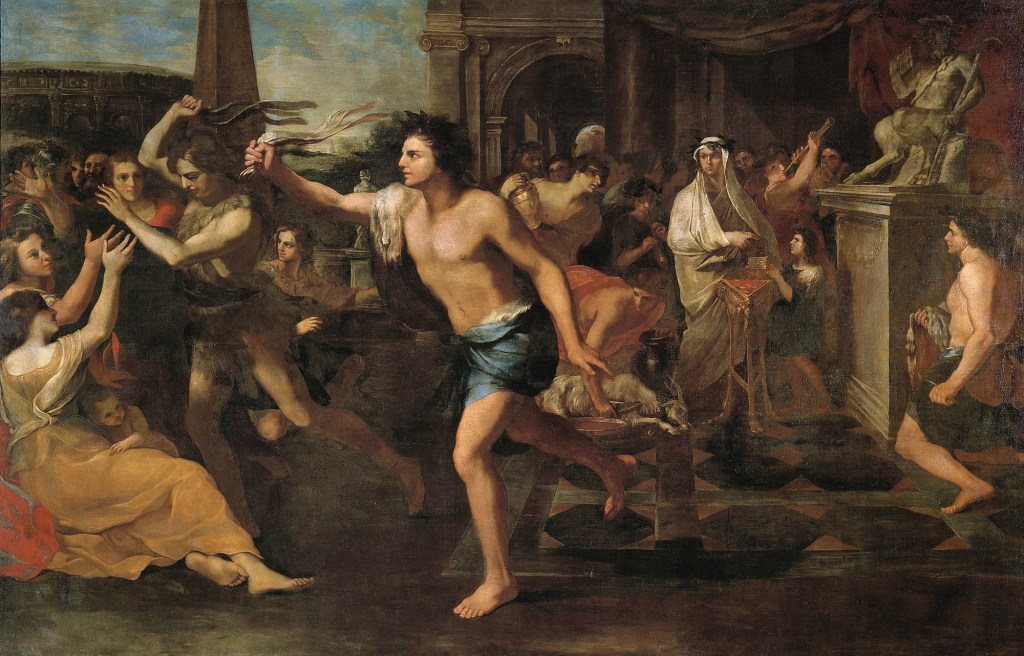
Sources state they used the sacrifice’s skin to make whips and loincloths; therefore, perhaps, they weren’t really mooning in the moonlight. Nevertheless, disrobed or not, these Brothers of the Wolf would run around, anticlockwise, and lash the crowds gathered for the occasion. The whips were thought to purify and even bring fertility; thus, women who desired to become mothers were often among the public during the festival.
The most popular Lupercalia is definitely the one in 44 B.C., when Julius Caesar added a third Luperci, called Iuliani, which was dismantled after the Ides of March. But this revered celebration stood through time, even after the Catholic Church prohibited pagan customs and rites. It persisted well into the 4th century, until Pope Gelasius I officially declared February 14th as St Valentine’s Day in 496 A.D.
The festival was utterly overshadowed by the day dedicated to love and slowly lost its fame. Some historians assert that there is an association between St Valentine and Lupercalia. Others, rather, proclaim that there is absolutely no tie between the two, and with all these diverse statements, we don’t know for certain which one is right.
Nevertheless, Lupercalia is such an interesting ritual and piece of our history, of the community, the city, and, above all, of the memory of Rome and its legendary roots, that it is impossible not to fall under its spell and fall straight into its jaws.
Up, Lupercalia by Andrea Camassei (circa 1635)
Sources:
Lupercalia and the Mythical Founding of Rome
Daily Life in Ancient Rome – Lupercalia
The Lupercalia in the Fifth Century
Lupercalia smentiti! Tutto quello che credevi di sapere sul 15 Febbraio


 The Library of the Unseen

Beautiful description of my sign! Thank you ☺️ 😘😘