“I cannot fix on the hour, or the spot, or the look, or the words,
which laid the foundation.
It is too long ago.
I was in the middle before I knew that I had begun.”
(Jane Austen, Pride and Prejudice)
Pride and Prejudice is one of my most beloved books and one of the most beloved all around the world. I longed to see the day I would have written about it, and at last it has arrived.
Let’s start with a little bit of info on its wonderful author.
Jane Austen is an incredible British novelist who was born in the Hampshire village of Steventon. Her affectionate family provided context for her writings, and it was based on her world made of minor landed gentry and the countryside that her outstanding stories come from. During her lifetime she was forced to publish anonymously under the pen name of “By a Lady”, as it was not deemed proper for a woman to pursue writing as a career.
Nevertheless, thanks to the heavens and the stars that she did, for she is not only the author of multiple loved novels such as Sense and Sensibility, Emma, and, of course, Pride and Prejudice, but most of all she is one of the greatest authors of all time.
Jane Austen is forever redeemed as one of the most romantic novelists in history, writing about herself and her experiences in the social world of the late 18th and early 19th centuries in England, talking about love, affection, yearning, and all things that make a proper hopeless romantic.
Like me.
But let’s talk about today’s novel of choice. Pride and Prejudice was published in 1813, originally titled First Impressions, and it is set in rural England. It follows the Bennet family, a ménage part of the gentry who have five daughters and no sons. Their major problem centres around the fact that their estate is entailed to a male cousin, making it crucial for at least one of the daughters to marry a wealthy man who can financially support the family once they lose their home. The beautiful Jane Bennet, the eldest of the sisters, quickly attracts the attention of Mr Bingley, a rich bachelor who has just moved into their neighbourhood, and the story itself begins with the courtship of Jane Bennet by Mr Bingley.
Our protagonist, however, is not Jane but the second eldest, Elizabeth Bennet. Since the beginning of the novel, she too draws the interest of an even wealthier man, a certain Mr Darcy. This dark, intriguing, and mysterious character certainly knows how to catch the eye of both the ladies of the gentry and the readers; however, the initial interactions between Elizabeth and Darcy are far from warm.
Elizabeth finds him excessively proud and forms a strong prejudice against him, allowing this perception to influence her judgements and decisions.
Precisely why the story is therefore titled Pride and Prejudice.
Its summary sounds pretty similar to every romantic comedy that has been made, right?
That’s because it is the first of its kind. Elizabeth Bennet and Mr Darcy don’t like each other when they first meet. They’re forced to spend a lot of time together, and throughout the chapters, they fall in love and end up getting married. And if you think that it seems pretty boring, then, first of all, dear reader, you’re on the wrong website. Second of all, you’re absolutely mistaken.
This is a safe space for all my fellow hopeless romantics and love lovers. Pride and Prejudice is extremely significant because it has impacted modern literature and entertainment as one of the most used archetypes for story structure. It is so important because, without it, our modern and contemporary books, movies, and TV series would be completely different. Romance especially tends to follow the same exact scheme.
Pride and Prejudice is the novel par excellence. Perhaps I am too biased myself; nonetheless, it is a remarkable book for its unique perspectives on 18th– and 19th-century British gentry, offering insight into their social customs, class dynamics, and gender roles through a woman’s eyes.
As I said, the first of its kind.
It was composed during the Georgian era but revised during the Regency one. A time during which the English were worried about Napoleon Bonaparte, and that is why militias had been formed around the country and why one of its postings in the book can be found in the invented town of Meryton. It is also important to note that England was entering the Industrial Revolution, all elements that are incredibly important in the story.
Its first edition was so well received by the public that a second and third one were printed in the following years, but it was only upon her death that her brother Henry revealed her authorship.
Jane Austen died young, but her novels live on forever.
The symbols and main themes in Pride and Prejudice are the houses, which represent the social status and their owner’s character, with social class as a restriction on who you can marry; then we have reputation, for both men and especially women to be judged upon; nature, which symbolises freedom, where Elizabeth goes to escape the constraints of society; and, of course, love.
Love as in burning desire, passion, affection, and respect. It is underlined multiple times throughout the chapters how it is of the utmost importance that Elizabeth, if she were to marry, would join in holy matrimony only with a man whom she respected greatly.
An equal marriage. Something that, in a society that forces social constructs on everyone, seems quite unattainable.
But Pride and Prejudice is a love story, and I must say, through our lovely Elizabeth Bennet, generations of readers have dreamed about a similar love, learning that pride and prejudice are indeed part of the human experience, and as such, they can be wrong.
All that remains for us to do then, dear reader, is to wish upon a star to find our own Mr. Darcy, for just as he says, “You must allow me to tell you how ardently I admire and love you.”
Which, if you ask me about it, is the most romantic thing I’ve ever heard.
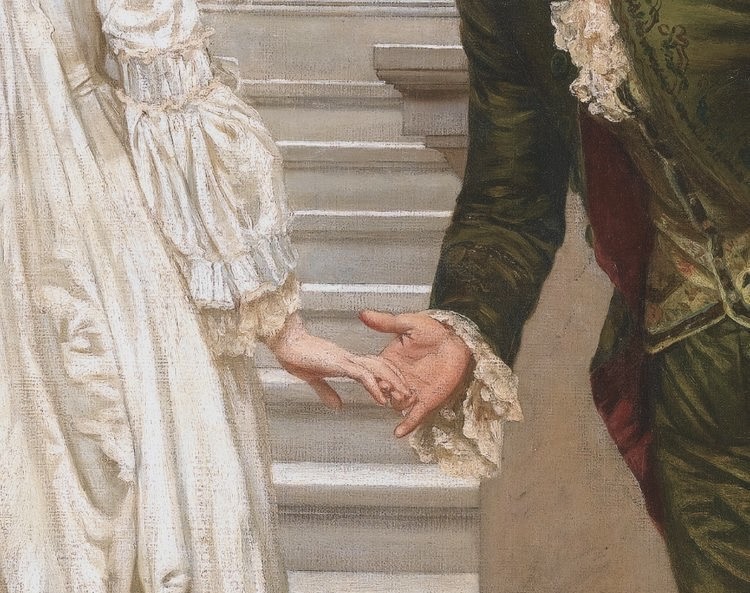
Up, À Bientôt by Valentine Cameron Prinsep (circa 1875)
Sources:
The Entire Pride and Prejudice playlist on Youtube by Ellie Dashwood (because she is amazing!!!)
Analysis of Feminism in Pride and Prejudice
The Theme Analysis in Pride and Prejudice
Pride and Prejudice by Jane Austen (1813)
All the Pride and Prejudice books I have at home in my library (I have like a dozen)


 The Library of the Unseen

Penny for your thoughts…