If you were to be a flower, which one would you be?
Think about it. Among all the tens of thousands of flowers that exist in the world, which one would you choose, and why?
I honestly don’t know. I like all of them. With their enchanting colours, wonderful fragrances, and sometimes even bizarre corollas. Flowers are quite incredible; no one can say otherwise.
Perhaps I would like to be a stunning wisteria, or an adorable forget-me-not, or the beautiful white blossoms that make their appearance on almond trees just as spring begins.
There are so many to choose from.
When I was little, one of the things that I wanted to do the most in my life was to find myself in the shoes of Alice in Wonderland. Yes, for the eat-me-not cookies, for the Cheshire Cat, for the tea parties with the Mad Hatter, and even for the terrifying Queen of Hearts; however, I wanted to be her, just for a little bit, first and foremost to stroll in the gorgeous Garden of Live Flowers.
I know, I know. Even if they were rude and very impolite, just the possibility of singing among them with bread-butterflies and rocking-horseflies was enough to make me daydream for hours.
But enough said, let’s focus on today’s topic, which is obviously about flowers, but more specifically about their secret language.
We may not pay that much attention when we see a bouquet or a flower arrangement, but flowers can hold a great deal of meaning. Just think about poinsettias that can be found everywhere during Christmas, or chrysanthemums that are gifted to mums for Mother’s Day, or, of course, about red roses and the grasp that they have on love and St Valentine’s Day.
People nowadays may not think twice about which flower they are giving to someone else, but about two or three centuries ago, the type of flower of your choosing was incredibly important. We must shift our focus to the Victorian era, particularly in England, because, as I said in my Pride and Prejudice article, reputation was utterly important, and you could be judged upon everything—even flowers.
With an increasing interest in botany and sometimes the need to communicate in secret to someone else (especially if we’re talking about two people of the opposite sex), Victorians came to a solution.
Floriography, or the language of flowers.
The custom was popular within all the social classes, but it became quite essential, especially for women of a high social standing. We’re talking about an affair of such impact that people had at least one flower dictionary or guidebook in their homes. That’s because deciphering what the bouquet and the arrangement could have meant was pretty difficult.
The main problem was that sometimes people had different interpretations and opinions about what a specific flower could have signified. Furthermore, the numerous books in circulation on the secret meanings of flowers—like Le Langage des Fleurs by Louise Cortambert or Floral Emblems: or A Guide to the Language of Flowers by Henry Phillips—compounded the issue.
For a society ready to criticise itself for every little flaw, one would think that it would at least have a consistent secret code, but no. The dictionaries were a great success in the rest of Europe and even in America; however, most of the time they had different interpretations, and that definitely did cause quite a few misunderstandings.
Comprehending the message was a talent per se. It wasn’t only about the chosen flower, but it also was about whether it was arranged in a bouquet, the way it was arranged, the type of flowers combined, if there was an herb or a plant, and even the colour of its ribbon. It was also then relevant to take into consideration the way it was given, specifically with which hand, and the way it was taken. Then we have the position of the ribbon, and obviously the condition of the flowers, where withered and perished undoubtedly meant disdain.
Victorians certainly knew how to occupy their time!
I imagine they had so much fun trying to understand whether a bouquet meant love or rejection; nevertheless, despite their immense creativity and enormous success, it wasn’t during the Victorian era that a flower language was born. Herbs, vines, and blossoms…a secret meaning for plants has existed since ancient times. The lotus in ancient Egypt symbolised rebirth, due to the fact that water lilies close at dawn, sink under the water, and reopen at sunrise, linking them as well to the sun god Ra, who was said to reincarnate every morning; poppies in ancient Greece were associated with Hypnos, god of sleep, and Morpheus, god of dreams, due to their hypnotic abilities; and how could we forget about the alluring red spider lily—higanbana in Japanese—typically linked to death in Japan because it is often planted near graveyards.
It seems that the infinite meanings of flowers, although the Victorians have played a great part in popularising their secret language, have always existed. We may never know why and when it was born, but that only adds to its mystery.
So, now you can look up plants and their significance and perhaps gift them to that someone you very much like or that someone else you very much hate. The most marvellous thing of it all is that you can play around with your choices in any way you like.
For example, daffodils mean unrequited love; daisies are for innocence and purity; bluebells for kindness; violets for faithfulness and modesty; rhododendrons for enemies, a warning; and red roses for love.
Therefore, now that we have reached the end of the article, let me ask you once again, dear reader… If you were to be a flower, which one would you be?
And why?
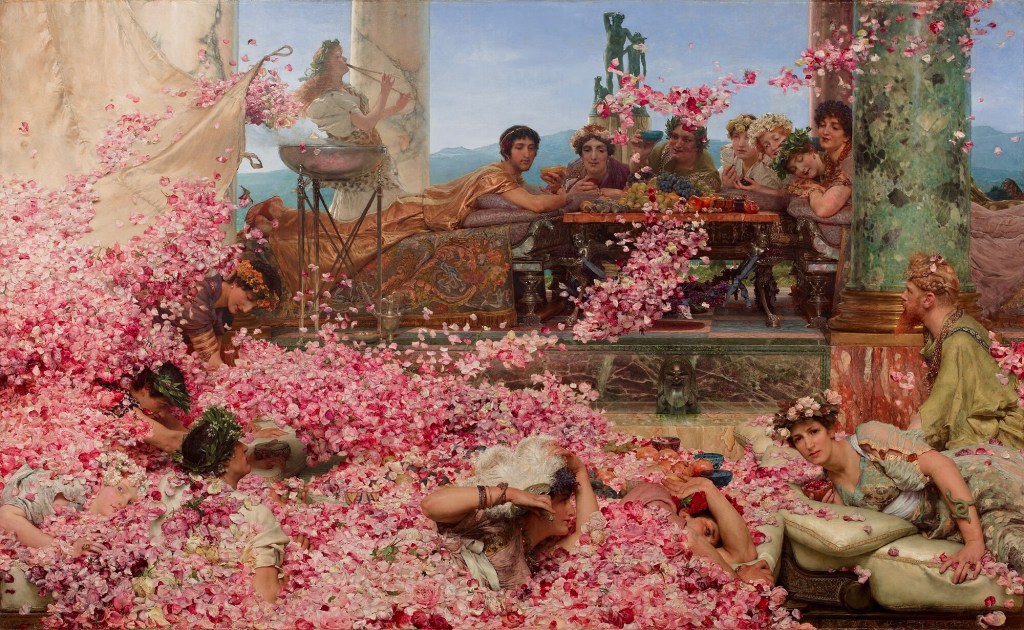
Up, The Roses of Heliogabalus by Sir Lawrence Alma-Tadema (1888)
Sources:
Floriography: The Secret Language of Flowers in the Victorian Era
Floriography: The Secret Language of Flowers
What is the enchanting Language of Flowers?
Le Langage des Fleurs by Louise Cortambert (1850)
Floral Emblems: or a Guide to the Language of Flowers by Henry Phillips (1831)


 The Library of the Unseen

Penny for your thoughts…