Yellow, white, green, or red, perhaps with a splash of milk, lots of sugar, and a slice of lemon, you can drink tea however you like it.
I love tea, especially during wintertime, and my cup is never empty.
Nowadays, this comforting beverage is enjoyed all around the world, and we can certainly find it in every corner store. It is often traditionally associated with the English and Great Britain, but—like I always say—when talking about something, it is of the utmost importance to recognise its roots and honour its origins.
And with tea, China is the one we must be grateful to.
Legend has it that in ancient China in 2737 B.C., the Emperor Shen Nong (the Divine Farmer) tasted about 100 plants. It is said that 72 of them made him ill, while only a single one cured him from all sicknesses, as a leaf from a nearby tree drifted into his pot and he gulped it down. We’re talking about the Camellia sinensis, also known as the tea plant, the same exact one we also use today to make tea.
However, even though the plant might be the same one, originally tea was consumed very differently from how we do it nowadays. For millennia, in fact, it was chewed as a vegetable or cooked with grains before it was even thought to drink it.
The tea plant comes from the southern regions of China, and the tradition of having it as a beverage may have in fact begun for medicinal purposes in the Sichuan or Yunnan areas, eventually spreading to the northern parts of China.
Scientifically, tea does not cure illnesses, even if it has lots of health benefits; nevertheless, it’s wonderful how, then or now, we have been enjoying a hot cup of tea for centuries.
Once it shifted from food to drink, the standard preparation for it became to heat it up, pack it into cakes, grind it into powder, and mix it with hot water.
During the Tang Dynasty (618-907), Japanese monks introduced the plant and beverage to Japan, who eventually developed their own rituals and ceremonies, and with that, the spread of tea began, reaching Korea and Vietnam as well.
Therefore, as the beverage became more and more popular, reaching other parts of the world, China grew its power and large monopoly over tea, making it one of its essential export goods. However, as history teaches us, once European countries arrived in Asia and understood how great tea was—with their constant need to colonise half the planet—things began to shift.
The recognition for having brought tea to Great Britain, particularly among the aristocracy and nobility, is given to Queen Catherine of Braganza; however, before talking about that, we need to focus on a few things.
Britain’s relations with both India and China are terribly complicated. I cannot summarise them in just a few sentences, but I’ll try my best.
At the dawn of the 17th century, as multiple European powers found themselves very interested in maritime explorations, discoveries, and exploitations of lots of countries, the whole lot decided to each establish companies to do these said explorations, with the British East India Company being the biggest one of them all. Believe it or not, at that time personal interests and political affairs were even more tied than in our current state of the world. Thus, meaning that, although it might not have seemed so, these English expeditions in both the Americas and Asia were done with the purpose of stealing from other European countries (Spain, I’m looking at you) and enriching the British Crown.
Which they did.
The etymology of the word ‘tea’ falls into the broad groups of te, cha, and chai.
‘Cha’ entered the English language via the Portuguese, while ‘te’ arrived via the Dutch. But the first one to bring it right to the English court, as I already said, was Queen Catherine of Braganza, a noble Portuguese woman, who married King Charles II in 1662.
As part of her dowry, Queen Catherine brought large quantities of tea to England, even if it was still mainly used for medicinal purposes. However, it didn’t take long before the beverage became fashionable among the nobility; that is because Catherine popularised it as well as a full-on experience. By the end of the 17th century, much of the British aristocracy were enjoying hot tea in porcelain cups and mugs. Not long after, in the early 18th century, it began gaining the reputation of being a ladies’ drink, not because it was in any way particularly feminine, but because at that time coffee was primarily considered a man’s drink. Women were not allowed in London’s coffee houses after all.
Throughout the 1700s, the price for tea dropped drastically; however, it wasn’t until the 1840s that the custom of the afternoon tea was finally invented. Credit for this change is often given to Anna Russell, 7th Duchess of Bedford—a little lady with a big appetite and even bigger opinions.
During the industrialisation, as wealthy English people were having their supper later and later in the day, right between four and five o’clock, the Duchess would complain about a sinking feeling and indulge in a pot of tea and some bread or cakes. She then began inviting her friends to join her daily ritual, and although it may have been done secretly at first, being a companion of Queen Victoria, it quickly received approval from her Majesty herself.
Now, after this short history lesson, let’s talk about tea.
As I already said, there are different variants of tea, like yellow, white, or dark, distinguished mainly by their oxidation and heating process. You can add honey, sugar, and some milk to it, and there are many foods you can savour with it, like crumpets, petit fours, cucumber sandwiches, scones, and—the mother of all teatime treats—the Victoria Sandwich.
Whilst the afternoon tea could be considered an informal event as well, sometimes even without sending an official invitation, we all know that life during the Victorian Era was quite a nightmare. As the lady of the house, organising the event was not a simple task, and you needed to be impeccable. Everything was important: the room chosen, the tea set, the food, the atmosphere, the type of guests, how you used the space, and so on.
But, let me tell you, even more exhausting were the rules you had to follow as a guest.
You had to remain at least half an hour, never squeeze the handle of the cup with your whole hand (the little finger just raised slightly), and when using the teaspoon, you should have never made a sound, only doing up and down movements. The saucer always had to be on the table or on your lap; after every sip, the cup needed to be put down, and the teaspoon necessarily needed to be behind the cup or to the right of the handle.
You had to never blow on the tea, never take a big bite of a pastry, never drink and eat together, and never wipe yourself with your own napkin.
In short, real torment.
We, as a society, often find ourselves romanticising the Victorian times. Tea has indeed become an adored and celebrated tradition all around the world, but I do have to say that, although a romantic myself, I’m deeply grateful that now we can enjoy tea however we like it.
It’s incredible how people exactly like us have been drinking it for a very long time.
It kind of makes you think that we’re truly all the same even after centuries.
Amazing, isn’t it?
Anyway, I swear I’ll put an end to this long article.
But before we can say au revoir, my dear, let’s savour this moment a little more. The way one savours the last drop of a perfectly brewed cup. And when the next pot is steeped and ready, you know where to find me.
The kettle will sing once again, but until then, dear reader, I’ll be waiting for you right here.
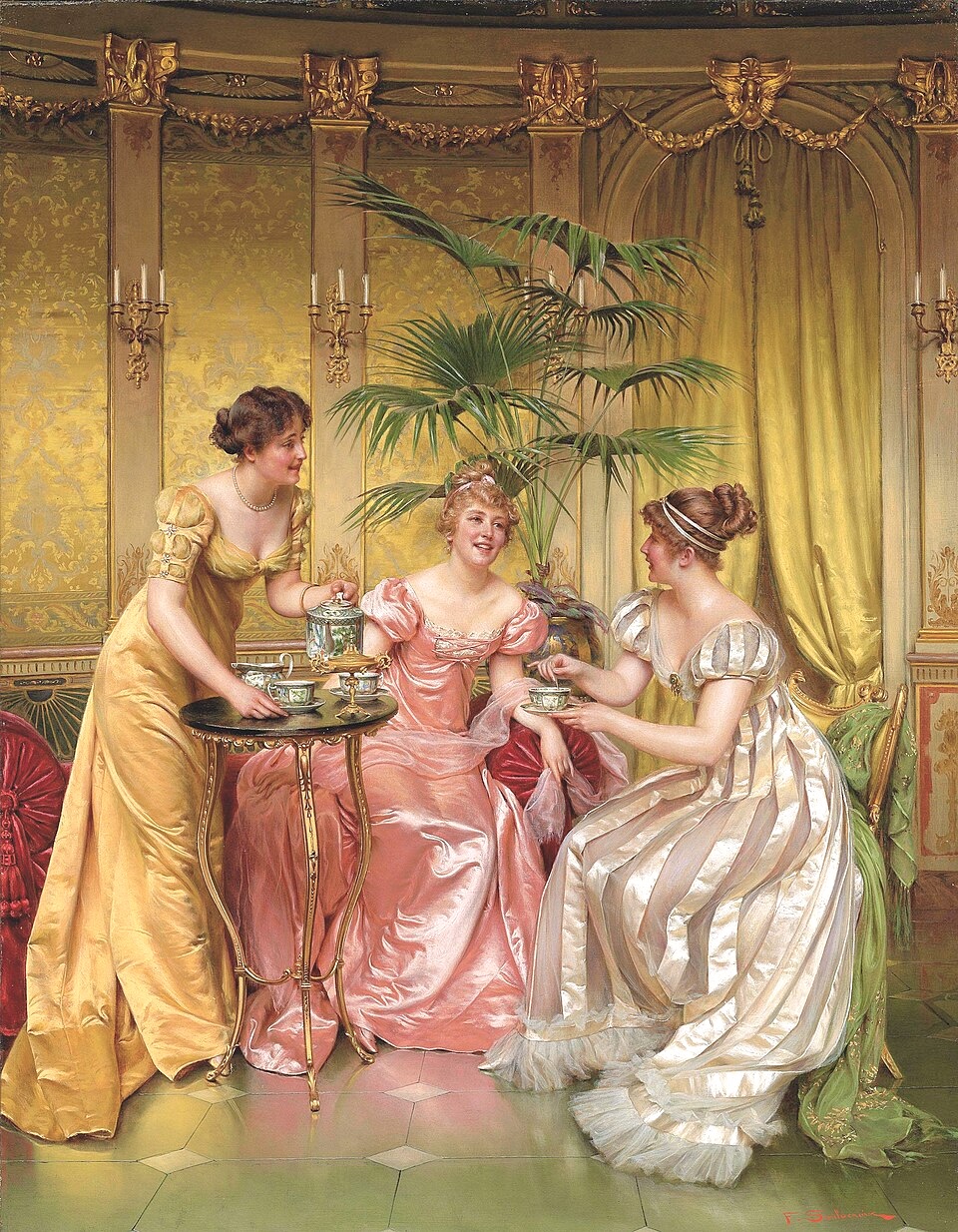
Up, Tea Time by Frédéric Soulacroix (before 1933)
Sources:
Tea: How Britain Screwed India and China
A History of Tea – From Myth to Modern Day
The Noble Origins of Afternoon Tea


 The Library of the Unseen

Penny for your thoughts…