Easter is an important Christian celebration, and yet, every year, as this festivity approaches, I can’t help but notice bunnies, rabbits, and hares almost everywhere.
Contrary to most beliefs, the Easter Bunny is not only an American figure. It does exist in Europe, and, even when I was little, upon waking up on Easter morning, I would always find my home filled with delicious chocolate eggs.
They are quite different from the ones we see in movies, cartoons, and books, but let’s get to that later.
Now, let’s focus instead on this mystical figure, for I’m sure you’ve probably asked yourself at least once, who is the Easter Bunny? And where did it come from?
Down we go into the rabbit hole.
First of all, originally it was called the Easter Hare, not bunny, even if they both appear in art, folklore, history, fables, and, of course, religion, as if interchangeable.
Bunnies, mythologically, are frequently connected to the moon and fertility, and it was prohibited to feast on their meat, for they were considered sacred.
Hares, in similar themes, were often revered, like in Celtic folklore, or depicted as clever tricksters, like in Native American legends. They were also linked to Aphrodite, goddess of love, and even her son, Eros, as a symbol of burning desire.
Up in Northern Europe, in Britain, it was believed that witches could transform into rabbits or hares, reinforcing their mystical reputation. And they can also be found frequently inhabiting the moon in East Asia’s mythology.
Let’s just say then that these peculiar and beautiful creatures have constantly appeared throughout history as images of sexuality, passion, harbingers of both good and bad luck, and mysterious, obscure, and honoured animals, not only for Christianity but for lots of different cultures.
In the Bible we can find lots of ambiguous opinions about them. They are described as being both impure and intelligent creatures, which unfortunately incremented further all the huge misconceptions about rabbits, mainly caused by the fact that they reproduce very rapidly. The mediaeval and Renaissance idea that they can give birth spontaneously was therefore quite popular, giving them the fame of being both linked to chastity and fertility.
But if we really want to talk about how our contemporary Easter Bunny came to be, we must shift our focus elsewhere. That is because this enchanting tradition does not come at all from the Bible (there’s no mention of it) but from German Lutherans when they emigrated to the Americas in the 1700s and brought this curious figure known as the “Osterhase” along with them.
An egg-laying hare, sometimes clothed, that gives gifts (eggs) only to good children—kind of like Santa and the Befana, if you remember my Epiphany article.
Therefore, is the Easter Bunny German?
Not exactly, but not wrong either.
According to the writings of Bede (673-735 AD), an early mediaeval monk, there was an Anglo-Saxon deity called Ēostre who symbolised fertility and rejuvenation and was accompanied by a rabbit. She was celebrated in April, and it is also presumably believed that the word ‘Easter’ comes from her name, while in most European languages, people refer to the festivity with terms that come from the Jewish holiday of Passover, such as ‘Pasqua’ in Italian. Jacob Grimm, one of the Brothers Grimm famous for their fairy tales, also argued in his 1835 Deutsche Mythologie that there was indeed a connection between the goddess and the Christian celebration; however, apart from a few opinions on the matter and Bede, there’s no clear association between Ēostre and Easter.
Forever remaining a mystery.
Nowadays, some people celebrate this mystical holiday with egg hunts, perhaps hidden around the house or in the garden, or perhaps in baskets with chocolates. They can be dyed or wrapped in coloured paper, sort of representing rebirth, not only for Christianity but especially for spring. Also, originally the new year began in March, which makes perfect sense.
In my home, we celebrate by gifting each other chocolate bunnies or huge eggs, typically containing a surprise, which, as a hardcore chocolate lover, I deeply love.
We may never know its origins, but the Easter bunny is adored around the world, bringing joy and painting our lives with all the colours of the rainbow. We may never catch it, like the White Rabbit in Alice in Wonderland, but my dear reader, isn’t it enchanting?
Pack your bags and get ready, the journey has barely begun, so down, down, down we go into the rabbit hole.
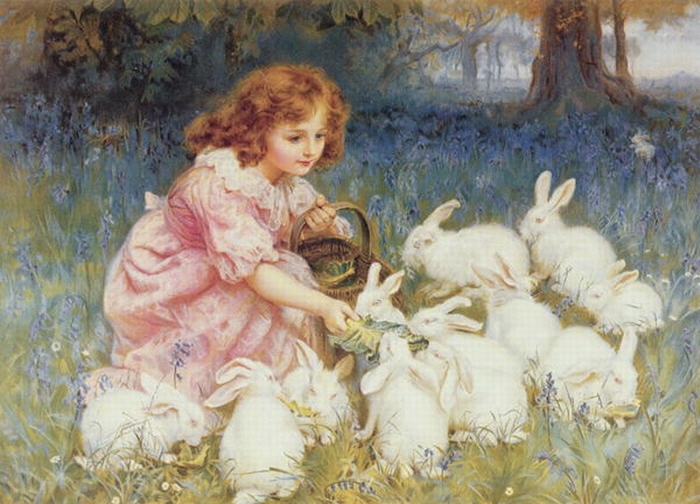
Up, Feeding the Rabbits by Frederick Morgan (circa 1904)
Sources:
The Ancient Origins of the Easter Bunny
Easter Bunny Origin – How Did the Bunny Become an Easter Symbol?
The Easter Bunny: Evolution of a symbol
Ēostre – Real Goddess or Bede’s Invention?
Eostre and Easter: ‘Rebranding’ a Spring Goddess to Fit Christianity?


 The Library of the Unseen

Penny for your thoughts…