Long before they danced on flower petals or flitted through moonlit gardens, and long before they were the winged wonders gracing bedtime stories, fairies were enigmatic beings born from mist, nature, and mortal fear.
The type of fairies that I have grown up with are sweet, delicate, kind, and feminine for the most part.
You must imagine my surprise when I began my research on them and all I could find were the words terrifying, dark, and even demons.
In most old books and articles, fairies are described as sacred and liminal spirits who live at the borders of the known world. Their origins are deep and tangled, rooted in ancient beliefs about nature, death, and unseen forces.
But let’s start from the beginning.
The word ‘fairy’ comes from the Latin fatum, meaning ‘fate’, and evolved through the Old French faerie (which is why some like to use fae or faeries), which once referred broadly to enchantment and the world of the fey.
The early conception of fairies that we can find in old documents was far removed from today’s dainty sprites. They were more akin to elemental spirits, fallen angels, or remnants of forgotten gods.
Our first stop is Northern and Eastern Europe, with their enchanting and mesmerising myths, but the good people can be found everywhere around the world.
In Celtic mythology—particularly Irish and Scottish—these beings were known as the Aos Sí or the Sídhe, connected with the ancient burial mounds that dot the landscape. These hills were seen as portals to the Otherworld, a realm coexisting with our own with eternal youth, beauty, health, and joy. The Sídhe were often depicted as powerful, prideful, and easily offended creatures that might have blessed a harvest or blighted it and guided a traveller or led them to their doom. Some legends suggest that they are the Tuatha Dé Danann, a race of godlike beings defeated and driven underground by mortal men.
Delving deeper into the Scottish folklore, we also discover that they divided fairies into two courts. We have the Seelie and the Unseelie, sort of like a society made of good and evil. The first ones included fae who might have shown kindness and doted on humans, while the second ones were described as malicious and cruel, known for attacking without provocation.
In Germanic and Norse traditions, we find the àlfar (elves), who too came in both light and dark forms. The darker types, such as the svartàlfar (black elves), were associated with death, mischief, and illness. These creatures were said to be able to enter your home, influence your dreams, and bring strange maladies unless properly appeased.
A theme that seems to be present in every tale.
In Slavic folklore, instead, fairies blurred with spirits like the Rusalki—the ghosts of drowned women who haunted rivers and lured men to their deaths. Or house spirits, like the Domovoi, who helped with chores but turned malevolent if disrespected.
Then, if we shift our gazes elsewhere, we can also encounter them in different parts of Asia, in New Zealand, in Native American culture, and in many others. The most incredible thing about fairies, however, is that they are almost never described using the same name, nor do they have the same precise qualities.
But of one thing we can be absolutely certain: a fairy is a mythical or legendary creature, often depicted as anthropomorphic and portrayed in the form of a spirit, with either metaphysical or supernatural aspects.
Therefore, if we really think about it, anything could be a fae. Any being at all, and not just a pretty little winged lady.
I also think that it’s quite unfair that we tend to talk about them as either wholly good or wholly evil. Like I’ve written in my Long Live the Queen! article about the Snow Queen, we are discussing liminal creatures. Little souls that supposedly live at the threshold of the worlds.
Therefore, neither good nor evil.
And even their preferred habitats reflect perfectly the in-betweenness that makes them so mystical. Fairies seem to enjoy more spots like moors, hollow hills, shorelines, and doorways. But be careful. I’m not saying you’re supposed to go to these kinds of places to meet them, because to encounter a fae, for how enchanting it may sound, is not always a blessing.
Many ancient tales, for example, speak of changelings—sickly or deformed fairy children left in place of stolen human babies—or they tell of men who cluelessly ventured into woods and forests, going mad or never to return.
In response, throughout history, superstitions and protective rituals began to flourish against these little creatures. Humans seem to get scared very easily, especially of things they cannot comprehend. And their usual reaction always appears to be somehow the use of iron or silver, like charms, coins, or crosses. All things they used against the fairies, even though they also did offerings, typically made of milk and bread.
To speak of the fair folk meant risk, so euphemisms like ‘the Good People’ were used to avoid their wrath.
But then, the question slips out naturally: how come nowadays fairies are depicted in such a positive light?
It seems that a transformation began in the late Middle Ages and gathered momentum in the Renaissance. As the old beliefs declined, scholars and artists began reshaping the fae, bringing them into poetry, drama, and moral allegories. One of the most famous examples is obviously Shakespeare’s A Midsummer Night’s Dream, with fairies like Oberon and Titania.
By the 18th and 19th centuries, during the Romantic and Victorian eras, they were reimagined again, this time as delicate, ethereal beings symbolising innocence. Fairies became smaller, often winged, and adorned with flowers. Surprisingly the Industrial Revolution had a greater impact on the fae than I imagined. This important period, in fact, had made the natural world seem distant and commodified, and so the fairies quickly became an image of its lost wonder.
The Victorians in particular adored them. And I ask myself, why is it always them?
From paintings to children’s books, and then the infamous Cottingley Fairy photographs in 1917—faked by two young girls—they had become absolutely beloved.
Though the soft version of this creature has become the norm, the world of the fae still remains immensely diverse. Like the Aos Sí and the Seelie and Unseelie Courts, but also Pixies (playful tricksters), Brownies (house spirits), and many more. Many of them still retain their older qualities beneath the modern façade, demanding respect, living in secret, and punishing arrogance.
Personally, I’ve never seen a fairy, or at least I think… unless I have forgotten. It is said, however, that they still inhabit the wild, like ancient forests or hidden caves. But, truthfully, I think they live wherever belief persists.
I think they dwell in stories, dreams, and the magic only a child can see.
They are childhood’s wonder.
I have indeed heard of many people who claim to have encountered a fairy when they were young, and interestingly enough, in my home country, there is the belief that every house has a winged spirit.
I’ve never seen a fae before, but perhaps one day I will.
After all, I believe in everything. Most certainly, I believe in fairies.
And to believe, like Peter Pan once said, “All you need is faith, trust, and a little bit of pixie dust.”
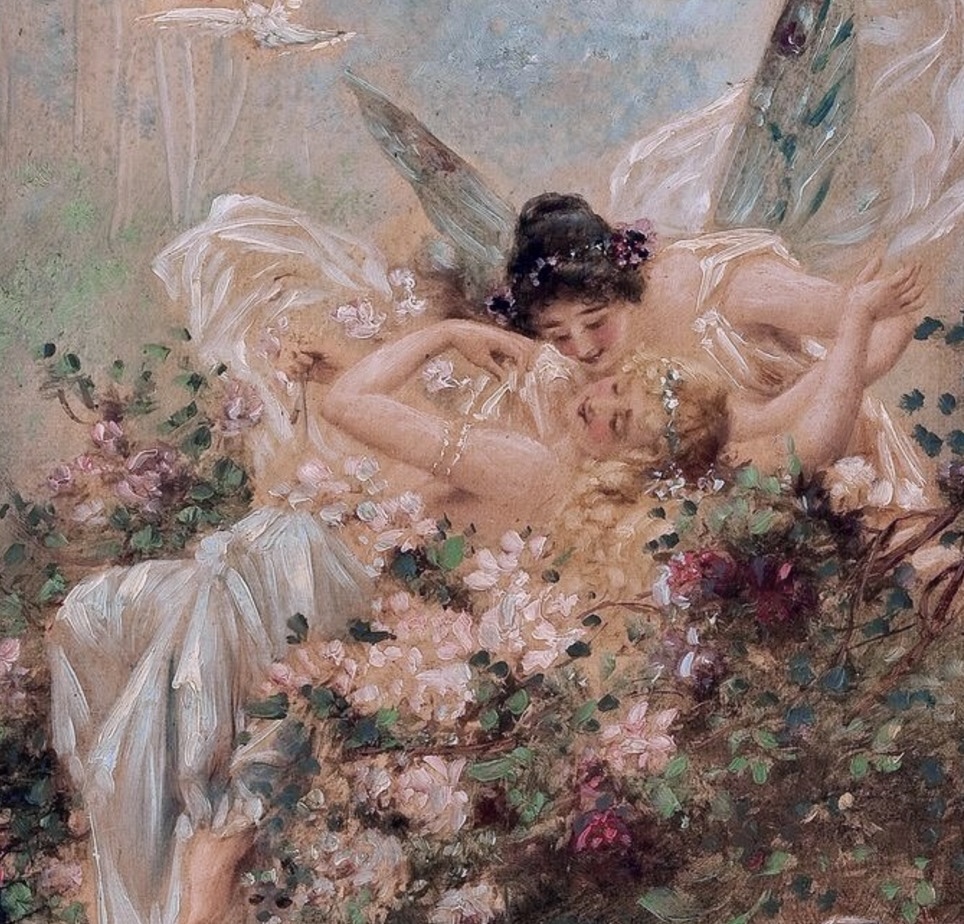
Up, Two Fairies embracing in a Landscape with a Swan by Hans Zatzka (circa 1900)
Sources:
A Brief History of Fairies and Fae Folk from Around the World
Fairies Light to Dark: The Many Forms and Creatures
The Fae Folk: Your ULTIMATE Guide to Fairies
On the Origin of Fairies: Victorians, Romantics, and Folk Belief
Fairies: The Myths, Legends, & Lore by Skye Alexander (2014)


 The Library of the Unseen

Penny for your thoughts…