The eye of heaven, Sol, Helios, and Apollo; it may have many names, but for most of us, it is known as the sun.
As we approach the summer solstice (the longest day of the year), and having written an ‘Ode to the Moon’ article seven months ago, I just couldn’t not do one about our blazing and magnificent star.
The sun, unlike our satellite, does not change, nor does it have phases. It is constant, rising every day, whether we’re ready or not.
But exactly like the moon, it is just as ancient and as sacred. Civilisations have worshipped it, danced beneath it, and even sacrificed to it. People adore it and have adored it for centuries, even if it can be quite unbearable during the summer months, making it not only a symbol but also part of our human history and life.
From the Egyptians, who honoured Ra, god of the sun, to the Aztecs, who built pyramids in alignment with solstices, many cultures across the globe and time have revered our star as divine. The Celts celebrated Litha, the midsummer festival, lighting great bonfires to mirror the solar blaze, and even nowadays, lots of people celebrate the summer solstice, commemorating the sun and calling its light.
It’s easy to reduce it to ‘just a star’ or a mass of burning gas. But if that’s all it is, why do we turn our faces towards it like sunflowers? Why do we feel more alive in summer? And why does sunlight, sometimes, feel like love?
Even science and modern spiritual practices acknowledge that the sun has an enormous influence not only on nature and animals but even on us. In astrology the sun represents the self, the essence, and the soul’s core. Your solar return (your birthday) marks a personal new year, and I think it’s very cute how we basically not only honour ourselves but also the sun.
While the moon governs the unseen, the internal, and the intuitive, the sun, instead, is the realm of action and vitality, which, in my opinion, perfectly reflects this time of the year and, of course, the warm season. They are both luminaries, which means that they are not planets but two celestial bodies that give light. They are indeed linked to feminine (the moon) and masculine (the sun) energy in many traditions, but not in the stereotypical submissive and dominant sense. They work together, and both of them are extremely important.
When we speak of the moon, we often speak of phases, like waxing, waning, full, new, and dark. She changes nightly, and in many pagan and mystical practices, these phases mark moments of intentions. And that’s also why our pearl in the sky is considered feminine, not only in myth but also connected to women with their cycles of rest and growth.
Like I’ve already said, the sun does not have phases, but it has a rhythm too. It is definitely less immediate and more stretched across the calendar, but it does indeed exist. Where the moon measures the month, the sun, in fact, governs the year. Its stages are not nightly, but they are seasonal. To understand them better, let’s talk about the two solstices and the two equinoxes, in winter and summer and in autumn and spring, respectively. They divide the sun’s cycle into quarters, like a great, golden wheel, and in some cultures and traditions, these solar stations are considered sacred days. Like, as I’ve already written, Litha (midsummer), Yule (midwinter), Ostara (spring equinox), and Mabon (autumn equinox). These are not just festivals of weather but true spiritual thresholds.
It is nearly impossible to talk about the sun without talking about the moon. People, in fact, often call them lovers, like eternal opposites chasing one another across the sky. A true star-crossed lover tale. But me personally, I prefer to see them as siblings. Or twins. Or counterparts.
Not chasing but balancing.
Like Artemis and Apollo, born of the same mother, watching over the day and night in turn. One is the moon. The other is the sun. And one literally reflects the other.
Without the sun, the moon would be invisible to us, and when they meet, during those rare eclipses, our whole world holds and has always held its breath, for they are truly spectacular. I think we long for them, for both the pearl in the sky and the eye of heaven. Don’t tell me that you’ve never lifted your gaze just to stare and admire the moon or that you’ve never raised your head to the sky and let the sunrays engulf you completely.
We love them equally but differently.
But if, in my ode to the moon article, I invited you to follow her phases, to rest when she wanes and turn inward with the coming of winter, this time, I write to you to go outside.
Go outside, dear reader, stand in the light, dance in it, and enjoy summer to the fullest.
Because, as I’ve already said, being in the sunlight sometimes does feel like love.
Like loving and being loved, all at once.
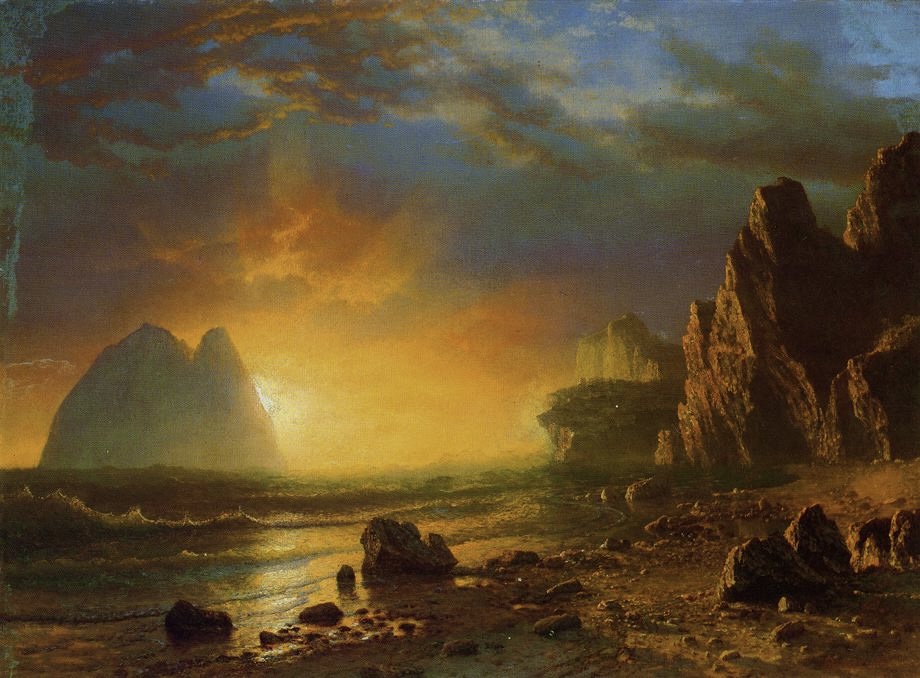
Up, Sunset on the Coast by Albert Bierstadt (1865-1866)
Sources:
The cultural significance of the sun in folklore across the world
Tales of the Sun: From myth to modern science
History of summer solstice traditions


 The Library of the Unseen

Penny for your thoughts…