I don’t remember the first shell I ever picked up, but I remember the feeling.
Like I had found something precious. Like it was a gift from the sea, and I had been chosen.
Perhaps you’ve felt it too—no, I’m sure you’ve felt it too, because finding a seashell in the infinite sand always feels like destiny.
Every summer, we do it. We walk the shore, barefoot and sun-warmed, and our eyes start scanning the sand for a little glint. Perhaps a curve, a spiral, or a shimmer, until we can find one, if we’re lucky enough.
When I was little, I used to feel a little bit jealous whenever one of my siblings found a shell and I didn’t. Like the sea had chosen them and not me. I used to pretend I didn’t care, but deep down, I did. And honestly?
If it happened again now, I’d probably still feel that same ridiculous little sting. Perhaps because shells have always sort of felt like tiny treasures or offerings. And I truly believe that there’s a certain romance in them. Not just because they’re so beautiful and unique, with their whorls and luminescence, but because they are so fragile.
Seashells can be huge, but sometimes they’re tiny, so tiny that they disappear in the palm of your hand. Can you believe that what we hold when we pick them up is the cast-off home of a creature?
It’s so absurd, and yet it’s true.
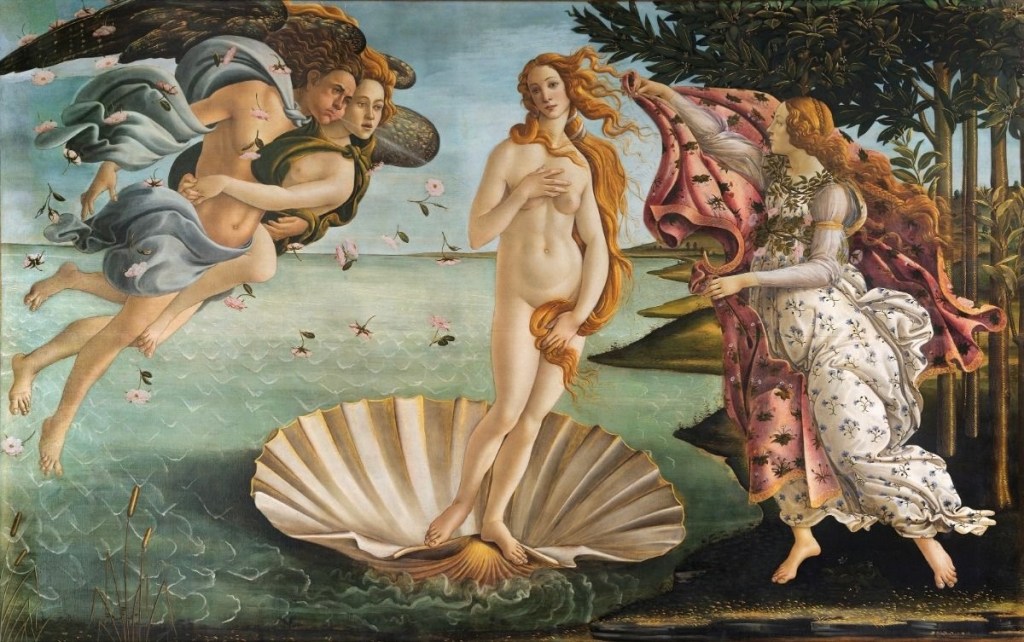
They have always carried meaning behind their form. In ancient times, they were used as currency, amulets, decorations, and even divine symbols. The most iconic image may very well be of Venus, or Aphrodite in Greek, rising from the sea in Botticelli’s famous painting (up above), standing upon a giant scallop shell like a gift from the ocean. In many traditions, in fact, shells are often associated with goddesses of love, water, and the moon.
In lots of cultures around the world, they have been worn as jewellery, sewn into ceremonial garments, used in burial sites, blown like trumpets, used as amulets for protection and travel luck, and so much more. In magic and witchcraft, shells are also commonly used in their practices. They are associated with water and lunar magic, making them great in spells for emotions, love, and protection.
But one of the things that I remember most vividly about seashells growing up—aside from when my twin found the prettiest ones—was learning about how ancient people made purple dye from them. Not the shells exactly, but from the sea snails that lived inside. It was called ‘purpura’, also known as ‘imperial purple’, and it was considered so sacred, powerful, and expensive that it was reserved only for emperors, nobles, and high priests.
I guess that the information about this peculiar colour had such an impact on me that it stuck with me.
But let’s go on.
Now, once you find a shell, there are many things you could do to honour them and thank the sea.
First of all, you could wear them. You could make a necklace, a pair of earrings, or even a bracelet out of them.
You could slip one into one of your pockets as a summer talisman. You could line your windowsills with them. And you could place them on an altar or in a corner of your home.
But, if I’m being honest, dear reader, whenever I get a gift from nature—no matter how tempted I am—I rarely bring it home.
Therefore, what I advise you to do is to hold it for a moment, admire it, say thank you, and then give it back.
Maybe it’s silly. However, I’ve come to believe that not everything is meant to be kept. Especially if we’re talking about the beach and the sea. Nature is meant to be protected, respected, and preserved. Nothing else.
But, before we conclude this article, and before you put the shell back into the water, let me give you one last piece of advice.
Something that my parents always used to tell me when I was little.
When you find a shell, hold it for a moment and bring it to your ear.
Then close your eyes and try to listen.
Do you hear it?
It’s the sea. It’s its breath, its whispers, and its memories.
A lullaby for those who listen.
And enjoy that moment, dear reader, for the sea has chosen you.
It has chosen you.
It has chosen only you.
Up, La Nascita di Venere by Botticelli (1485-86)
Sources:
The Story Behind the Seashells By the Seashore
The Cultural Significance of Seashells: Their Role in Art, Mythology, and Religion
The Many Uses of Seashells In Ritual Magic
Tyrian purple: The lost ancient pigment that was more valuable than gold


 The Library of the Unseen

Penny for your thoughts…