Ahoy, matey!
When you hear the word ‘pirate’, what comes to your mind? The Jolly Roger? An eyepatch? A wooden leg? Or a big bottle of good, old rum?
These are all vivid images and distinct portrayals of pirates, but how many of them are actually true? They have been indeed heavily romanticised by time, but, through this article, you might find, matey, that the real pirates were even more complicated and far more fascinating than you think.
Piracy has existed as long as there have been ships to raid and coastlines to exploit. Ancient texts from Greeks and Romans do in fact mention pirates as a constant threat to trade and security. The Mediterranean, with its endless trade routes, was a hotspot for early piracy. As a matter of fact, the word ‘pirate’ comes from the Greek ‘peiratēs’, meaning ‘one who attacks ships’.
Aye, aye!
Even Julius Caesar was famously kidnapped by pirates in 75 BCE. Legend has it that when they demanded a ransom, he insisted they ask for more, offended by the low price they put on his head.
Throughout the centuries, then, piracy flourished in areas where state control was weak or where sea trade thrived. And as maritime commerce expanded during the Age of Exploration, so too did the opportunity—and appeal—of theft, culminating in what we know today as the Golden Age of Piracy.
This period, which goes from 1680 to 1720, is often referred to as the ‘Renaissance’ of piracy. This was the era of Blackbeard, Anne Bonny, Calico Jack, Bartholomew Roberts, and more. Names that have literally become legend. Arrr!
Centred largely in the Caribbean, the American eastern seaboard, West Africa, and the Indian Ocean, this period was marked by a surge in piracy due to a mix of political instability, naval demobilisation after wars, and the booming of transatlantic trade. Despite their brutal methods, pirates of this era have been mythologised as rebellious outlaws (both men and women) who defied empires, carved out free lives on the open sea, and created floating democracies on their ships. Pirate crews, in fact, often shared plunder equally, voted on leadership, and even provided injury compensation, a stark contrast to the hierarchical and often cruel structures of naval or merchant ships.
But how do we know this? It is the way that pirates were covered by the news at that time that has shaped the many depictions of them we know today. In A General History of the Robberies and Murders of the Most Notorious Pyrates by Captain Charles Johnson, first published in 1724, are vivid descriptions of many of the pirates’ names I’ve listed above. Like Blackbeard, written as “beard was black, which he suffered to grow of an extravagant length […] he was accustomed to twist it with ribbons, in small tails […]”, making him sound terribly intriguing.
However, as you may already know, Johnson probably exaggerated the details, and it doesn’t help that all the romanticisation about pirates often obscures the reality of it all. We must remember that they were violent, organised criminals, and many were opportunists driven more by greed than freedom or justice. They raided villages, tortured prisoners, and enforced brutal discipline even on their own.
Though the Caribbean Islands are the first thing that pops up in our minds when we think about pirates, piracy has always been a global issue. In the Indian Ocean, pirates from the Arabian Peninsula raided coastal cities and merchant ships for centuries. In East Asia, Chinese pirates like Ching Shih (one of the most powerful ones in history) controlled vast fleets that rivalled national navies. I was honestly shocked to read her story. She was an amazing pirate who, at the height of her power, commanded a huge sea monster fleet whose tentacles wrapped around Korea and touched the coasts of Malaysia, with over 70000 men and around 2000 ships. Blimey!
She enforced strict codes of conduct, taxed coastal towns, and even bargained with the Chinese government on her terms. She was absolutely incredible, and her story challenges the male-dominated narrative of piracy, highlighting the scale and complexity of non-Western pirate networks as well. The most extraordinary thing about her is that Ching Shih was never even defeated. She negotiated a pardon from the Chinese government and retired from piracy with her wealth and title intact, protecting not only herself but all her fleet. She was outstanding.
But let’s go on, matey.
One of the murkier aspects of pirate history is the distinction between pirates and privateers. The latter were essentially legal pirates—sailors granted a government licence to attack enemy ships during wartime. As long as their violence served national interest, it was considered patriotic, making it so that the only real difference between a pirate and a privateer was literally paperwork and allegiance. The moral ambiguity about piracy is exactly this: sometimes it was rebellion, sometimes it was survival, and sometimes it was just business under another flag.
Now, is everything we imagine about pirates true? No. Probably not.
But a large part of their myths is indeed real.
Let’s debunk and prove some of them.
First of all, did pirates bury treasures?
Nope. Today’s image of the pirate owes more to Robert Louis Stevenson’s Treasure Island than to historical records. It is indeed from his book that the idea of a treasure map with an X written on it comes from. In reality, pirates did steal and capture cargo, but they never buried it, and they definitely did not create secret maps to find it.
Did they have eye patches and wooden legs?
Kind of. It happened that they injured themselves, sometimes quite seriously. Therefore, it wasn’t uncommon to see people with missing limbs or who had lost the sight of an eye. However, this popular depiction comes, once again, from Treasure Island and its many adaptations.
Did they make people walk on planks?
No. I think we confused that with Peter Pan. ‘Marooning’ (deliberately abandoning someone on a deserted island) was the most common punishment. However, being thrown overboard and death were obviously very popular as well.
Did they all use the Jolly Roger?
Yes and no. Flags were utilised to frighten the adversary to surrender without a fight; however, the legendary skull and bones flag is just one example of the many that pirates used. Most of them had their own design.
Did they all follow the Pirate Code?
Not really. Despite the mythic aura surrounding it, the pirate code was indeed a real thing, but not quite as formal or universal as we think. We’re not talking about ancient scrolls but practical agreements known as ‘articles’, drafted and signed by every member before setting off. The concept is often credited to Captain Bartholomew ‘Black Bart’ Roberts, although others had similar ones. It included rules like equal shares of loot for all, compensation for lost limbs, and prohibitions against fighting on board. Some codes banned gambling and drunkenness during battle, and Black Bart’s code even stated that lights were to be out by 8PM (my kind of person).
Did pirates keep parrots as pets and say “Arrr!”?
You won’t like the answer. Unfortunately, the way we think that pirates talked is not historical, or at least we have no proof of it. As for the parrots, they probably kept them, but rather as valuable things than pets.
Did they drink rum?
I guess so. But I bet there were pirates who simply liked to drink tea.
So then, why do we like pirates so much?
To be honest, I think I know why. Perhaps it’s because they embody contradictions. They were both brutal and democratic, romanticised and feared, free and hunted. They defied authority but often imposed their own. They lived outside the law but rarely outside violence. They also went against the gender roles of the era, with pirates like Anne Bonny and Mary Read, who fought alongside male crewmates. I think, in many ways, pirates became symbols of rebellion against oppressive systems. They represented and still represent a chaotic kind of freedom that we all crave. Although the reality of their societies is harsh, in our mind and imagination, they remain that type of adventurer we all aspire to be.
Perhaps one day we’ll all get to travel the world like pirates, free and fearless.
But until then, matey, hoist the sails, chart your course, and keep an eye on the stars. The wind is calling you, and so is the sea.
Now… Where’s my rum?
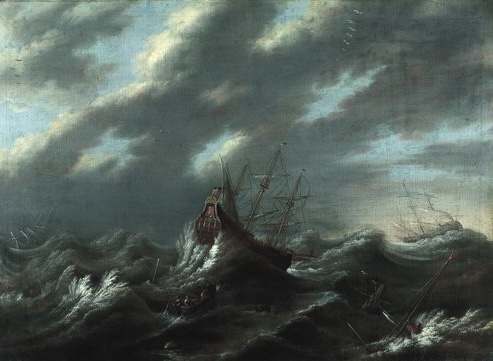
Up, Storm at Sea by Anonymous (mid 17th century)
Sources:
The ‘Golden Age’ of Piracy Explained
Historian Answers Pirate Questions
Etymology of the word ‘Pirate’
8 Famous Pirates from the ‘Golden Age of Piracy’


 The Library of the Unseen

Penny for your thoughts…