“A philosopher once asked, ‘Are we human because we gaze at the stars, or do we gaze at them because we are human?’
Pointless, really… ‘Do the stars gaze back?’
Now, that’s a question.”
(Neil Gaiman, Stardust)
I still remember the first time I saw a shooting star.
I think I was about eight years old, and I was travelling late at night with my family when it happened. To be completely honest, if I think about it now, the shooting star in my memory somehow resembles perfectly the one in Studio Ghibli’s Howl’s Moving Castle—flickering, sparkling, and a little bit too magical to be real. Perhaps, it was indeed just my fervid and childlike imagination, but at the end of the day it doesn’t really matter, because, real or not, it will always be a memory that I will carry with me and cherish for the rest of my life.
When I was younger, I was obsessed with stars. I wanted to know everything about them, and, for a short period of my life, I saw myself running right with them.
There’s something profoundly peaceful about a sky full of stars. Lying beneath the vast, glittering dome can make our daily, human worries feel extremely small, placing us within a much larger universe. I’m not going to lie, it does feel pretty humbling, but it’s also oddly comforting at the same time. I mean, we spend so much time, so many minutes and hours thinking about futile and pointless things that when we finally lift our heads and gaze at the great blue sky above us, we finally realise that… wow… it’s all insignificant. All our problems, and doubts, and fears, and insecurities, they’re all insignificant, because we are essentially just a tiny dot in the infinite universe and the thing we call life. Now, I’m not saying this to make all of you, all of us, feel minuscule, pointless, or worthless. Not at all. In fact, it’s quite the contrary. We are so small and meaningless that essentially it doesn’t really matter what we do, and yet, we choose to love. Isn’t that wonderful?
Of all the things we could do in our teeny-tiny lives, we still choose love. How amazing we are. And how lovely.
It is no wonder, then, that we adore constellations and starry nights so much—they speak to us and the dreamers within us—and it is no wonder that for poets, artists, and even scientists, they have always been symbols of beauty, longing, and eternity. They’re the oldest things we can see with the naked eye, and they’ve been with us since the beginning of our history.
Before we had calendars, clocks, or compasses, we just had stars.
They not only helped us navigate the world, but they also guided us through life. They invite important questions, some of which we still don’t have the answer to, like: What lies beyond them? Are we alone?
They ignite our curiosity, inspire exploration, and also stir imagination. But, most of all, stars symbolise hope.
‘Wishing upon a star’ may be considered a child’s game; however, the desire it expresses is something that stays with us, no matter the age.
But let’s go on.
The funny thing about stars is that the more you look for them, the more you realise how much they constellate our lives. Our connection to them is, in fact, etched not just in stories and science but in everything. Think about our very language and consider, for example, the word ‘disaster’. It comes from the Greek, meaning ‘bad star’, reflecting an ancient belief that stars could influence fate and misfortune. Think then about how they also show up again and again in the way we speak and think, like the term ‘star-crossed lovers’—doomed by fate, a phrase made famous by Shakespeare’s Romeo and Juliet. Or like ‘rising stars’ and ‘superstars’, we use celestial terms to describe talent and brilliance. Or again, when something seems destined or fated, we say that it’s ‘written in the stars’.
Like I said, they are quite literally everywhere.
Of course, then there are also astrology and astronomy, and while they diverged long ago, they both show how closely we’ve always tied our identities to the skies. Since ancient times, we have looked at the heavens for meaning and purpose. The Babylonians and ancient Egyptians charted constellations to mark seasons and guide agriculture. The ancient Greeks named the constellation we still use today, embedding myths and legends into the sky. In modern centuries, they became a gateway to science. And, even now, astronomy continues to unravel their mysteries, because if we really think about it, like I already wrote, for how vast the universe is, we know nothing.
The question comes easily then… why are we so obsessed with them? Why do we love them so much? Why do they feel so close to us and far away at the same time? Is it just because they’re beautiful? Is it because, with light pollution, we have lost the art of looking at the stars?
I don’t know, dear reader. And I don’t think I’ll ever be able to answer. But perhaps our deep connection to them lies in the fact that we are, quite literally, made of them. Scientists have confirmed that the elements that make up our bodies—carbon, oxygen, and iron—were forged in the hearts of ancient stars that exploded long ago. So, like physicist Carl Sagan famously said, “We are made of star stuff.”
And that could be it. It would mean that when we look up at the night sky, we’re not just seeing light from far away, but we’re witnessing ourselves.
Which, if you ask me about it, is so incredibly poetic.
So, dear reader, before concluding this article, let me give you some advice. In our fast-moving world, take a moment, from time to time, to stop doing whatever you’re doing, lift up your head, and just look at the stars. Although one of them could burst and explode occasionally, they remain the sole constant in our ever-changing life. So, just take a moment to look at them.
As a matter of fact, one of my country’s most magical summer traditions is nearing; therefore, what better time to do it if not now? Falling on 10 August each year, we Italians head to the beach or somewhere where light cannot reach and look to the night sky in hope of catching a glimpse of a shooting star and making a wish. It’s a rather cute reoccurrence, and I invite you to take part in it. Who knows, perhaps we’ll wish upon the same star.
As for the question I began this article with, I’ll take some liberty and answer it myself. I believe that the stars gaze at us back. That they observe us the same way we’ve always observed them, quietly reminding us that we’re not just looking at the universe… but that we’re part of it too.
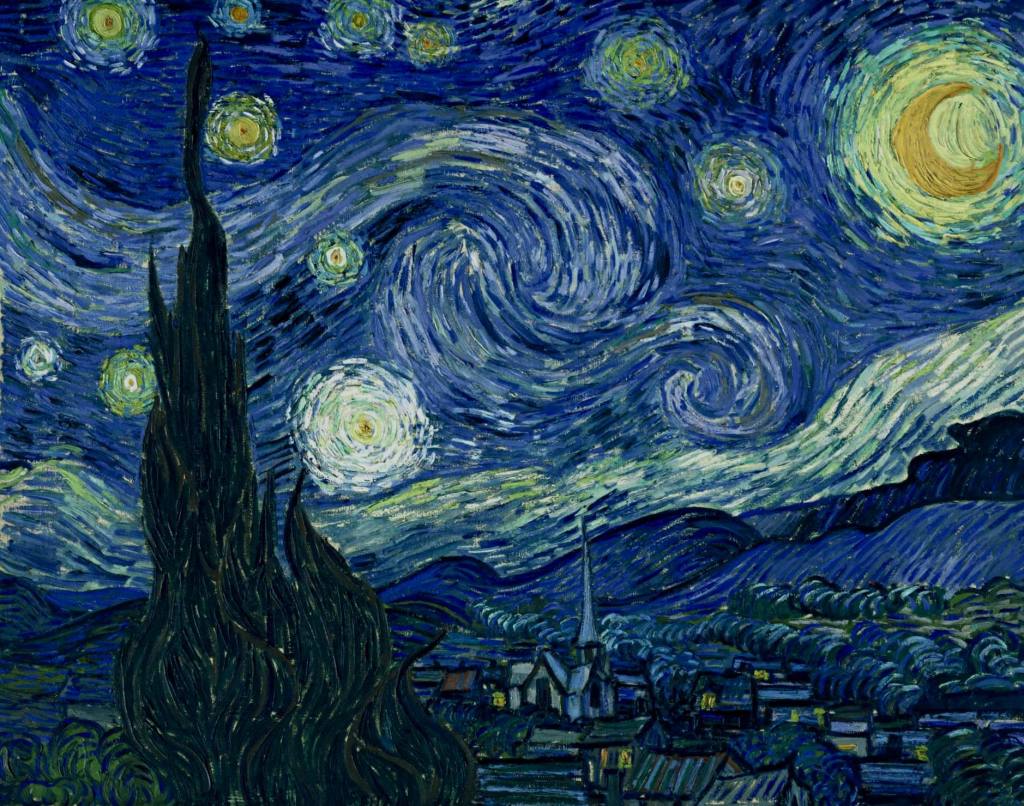
Up, The Starry Night by Van Gogh (1889)
Sources:
When did our ancestors start looking up to the stars?
7 Ancient Cultures and How They Shaped Astronomy
What lies beyond the stars: Exploring the endless depths of space
Are we really made of ‘star stuff’ and what does that even mean?


 The Library of the Unseen

Penny for your thoughts…