Candles are flickering all around, shadows are stretching ominously on the walls, people are gathered around a table, clasping hands together, fear is devouring you little by little, and then… you hear a knock.
The spirits are here.
As the leaves are starting to turn brown, orange, and yellow, and autumn is arriving, it seemed quite obvious to me to begin this Spooky Season with a chilling subject. I’m talking about one of the most creepy, disturbing, and unsettling topics… the Séance.
Even if you’re not familiar with the term, I’m quite certain that the more we delve deeper into this article, the more you’ll realise what I’m talking about. Because, in one way or another, the séance has travelled long and far, making its way all over the world. But let’s start from the very beginning.
According to the dictionary, the word ‘séance’ comes from the Old French ‘seoir’, which means ‘to sit’ and has nothing to do with spirits or ghosts. Originally, in fact, it referred to any large gathering, specifically political ones; however, its significance took a strange turn when, during the 1830s, it began to be used to describe the meetings of those who practiced two popular beliefs at the time that later developed into what we nowadays know as Spiritualism. The two forms were ‘animal magnetism’ and ‘mesmerism’, but we won’t focus on them today. Spiritualism has many types, but the one I’m referring to is the social and religious movement that took the 19th and early 20th centuries by the throat, sweeping across America and Europe. It captivated the public imagination, making the impossible seem possible: summoning the dead. Spiritualism is, in fact, based on the belief that the departed souls can interact with the living and that the living can call for the deceased even from beyond the grave. This typically happened with the presence and the help of a ‘medium’: a person, often a woman, who can communicate with the departed. It is believed that mediums possess exceptional sensitivity to the spirit world and that they stand as conduits between the realms, channelling voices and, of course, delivering messages. Essentially, if we were to describe them in other words, they are psychics who can interface with the spirits in other dimensions and who are fundamental when talking about séances. So, as the terms ‘spiritualism’ and ‘medium’ grew in the 1800s, so did the word ‘séance’, altering its meaning and forever becoming connected to the occult—a gathering of people who attempt to summon the dead.
Now, communing with the dead is nothing new. Indeed, it appears to be a common desire across different civilisations to talk to the departed. Long before Victorian parlours were filled with people eager to summon spirits, this type of spiritualism, like I already wrote, existed in various ways. It is not quite considered a form of necromancy; however, it can be traced back as a descendant. The ancient Egyptians, the Babylonians, the ancient Greeks, and more—they all used necromancy, or at least a practice that is extremely similar to the séance. Naturally, contemporary meetings to summon the departed can differ quite a lot from the Victorian ones—with the usage of new objects and methods—but the core stayed the same.
Therefore, although its many predecessors, the séance as we know it today was officially born during the 1800s, marking a pivotal era. It came into existence during the reign of Queen Victoria (1837-1901), throughout a critical period when people—like I already said in many of my articles—sought comfort in nature, away from the rapid industrialisation and urbanisation of the time, becoming an entertainment, a belief, and a profound cultural change.
The origins of this shift are often traced to Hydesville, New York, in 1848, where the Fox sisters (the pioneers of Victorian spiritualism) became a huge phenomenon. A sensation that managed to enrage even important figures, like Harry Houdini, and deceive even great minds, like Sir Arthur Conan Doyle.
Yes, I’m aware it sounds crazy.
The Fox sisters were actually three, but it’s specifically Catherine and Margaretta Fox who claimed to be able to communicate with the spirits through a series of mysterious and baffling raps on the walls and floors, more widely known as knocks. Their house had the reputation of being haunted; therefore, when the two sisters stated that they could hear unusual ‘bumps’, the fault of it all fell on the former resident of the house—a man who was already dead. News of this ghostly encounter spread like wildfire, and the Fox sisters quickly gained popularity, becoming the very first celebrity mediums and sparking a movement that would enthral and attract even scientists and politicians alike. As a matter of fact, séances became such a fashionable experience that (obviously) primarily the upper class could afford one. Now, there’s no proof of it, but it is indeed said that even President Abraham Lincoln and his wife, Mary Todd Lincoln, held one, allegedly in the Red Room of the White House. But of this particular experience, I guess we’ll never know if it’s true.
The ghost and spiritualism fever continued to grow until it reached its golden moment in the late 19th and early 20th centuries with the rise of many famous mediums. However, lots of believers only means that there were lots of sceptics as well, and, especially, lots of people who wanted to expose them all. It was, in fact, in 1888, that Margaretta Fox confessed that their séances were a faux and publicly demonstrated how their hoaxes worked. This admission, and all the exposés that followed, resulted in the decline of spiritualism, while the rise of scientific explanations for paranormal events flourished and thrived.
Many were the popular mediums at the time, more often than not for their dramatic way of doing séances, but how exactly did it all work?
Like I wrote at the very beginning, it starts with the participants sitting in a circle in a dimly lit room, holding hands, with a medium or guide leading the session, inviting spirits and ghosts to come forward. The most spectacular thing about séances, however, is that there’s no ‘specific’ method. In fact, I guess they became so popular specifically for how theatrical and extravagant they could be. Some of the most used methods include:
Writing—where the medium would let their hand be used by a spirit or unseen force to write a message.
Trumpets—hollow cones that made whispers and voices more audible.
Rapping—knocks or bumps to answer questions.
Table Tipping—where the table would shake or even levitate during the sessions.
Trance—when mediums would enter a trance state to connect with the dead and let them influence their thoughts and actions.
And the most disturbing one of them all, Ectoplasm—a substance or spiritual energy that is exteriorised.
Lots of accounts state that this latter one happens when the medium is in a trance state. Sometimes it is described as light in colour, sometimes as dark, sometimes with a strong odour, and mostly as fraudulent. I’m not going to go into details; however, like most of the things about séances, it has yet to be proven true.
Now, I don’t know whether séances are real or not. I’ve stated many times before that I do indeed believe in anything. However, I can be sceptical as well, and this particular way to connect with the dead has yet to fully convince me. Either way, I’m fascinated by them, but whether they’re genuine or not, and whether you’d like to participate in one or not, dear reader… always remember one thing.
The boundary between the mortal and spiritual world exists for a reason, and we, as humans, are not meant to cross it.
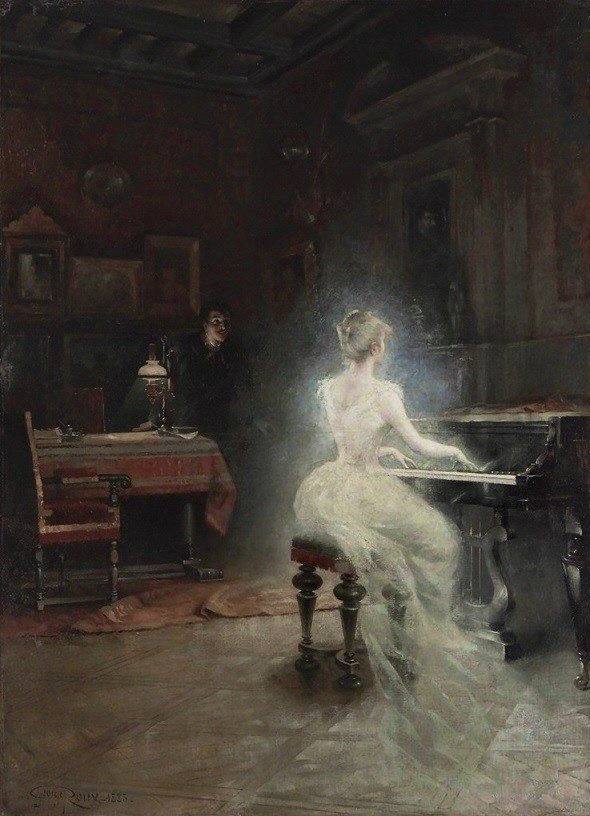
Up, Spirit by George Roux (1885)
Sources:
Calling the Spirits: A History of Séances by Lisa Morton (2020)


 The Library of the Unseen

Penny for your thoughts…