“ ‘Né creator né creatura mai’,
cominciò el, ‘figlioul, fu senza amore,
o naturale o d’animo; e tu ‘l sai.
Lo naturale è sempre sanza errore,
ma l’altro puote errar per malo obietto
o per troppo o per poco di vigore.’ ”
(Dante Alighieri, Purgatorio XVII, 91-96)
“ ‘Neither Creator nor his creature, my dear son, was ever without love, whether natural or of the mind,’ he began, ‘and this you know.
The natural is always without error, but the other may err in its chosen goal or through excessive or deficient vigour.’ ”
In this passage from the seventeenth canto of Dante Alighieri’s Purgatorio, Virgil is explaining to Dante the very foundation of human morality. The most striking thing, however, about these two tercets is that at the heart of his teaching, Virgil claims that every action, whether virtuous or sinful, is rooted in love.
In this enlightenment, he distinguishes between ‘natural love’ (the instinctive desire implanted by God, which never fails) and ‘rational love’ (the one of the mind and the one we exercise through free will), but he also says that ‘rational love’, unlike the natural one, can go astray. It may fix itself on an unworthy object, pursue it too fervently or even too weakly, and thus stray from the right path. It is from this misdirection that the protagonists of Dante’s Purgatorio and today’s article arise. You’ve probably already guessed it from the title, dear reader, because today we’ll talk about the Seven Deadly Sins.
Dante reframes sin not as the presence of hatred, but as the corruption of love itself. The very force that should draw the soul upward towards God becomes twisted, leading instead to disorder and ruin. But anyway, we won’t focus on The Divine Comedy, not yet—that’s a topic for another day. We’ll focus only on the Seven Deadly Sins that corrupt our world, otherwise known as The Capital Vices or The Cardinal Sins.
Pride, Greed, Wrath, Envy, Lust, Gluttony, and Sloth.
I’m certain you’ve heard about them in some capacity, dear reader, because although they are primarily a Christian concept, there are similar beliefs in many other religions around the world. But apart from the idea that they dictate how a person should and should not behave and live their life, what are they really? And where do they come from?
To answer these questions, we need to travel back in time to a century where the notion of the Seven Deadly Sins did not yet exist. Or better, it did exist but not as we know it today, and instead of seven—surprise, surprise—there were eight.
According to Roman Catholic theology, the Seven Deadly Sins are the vices that spur other sins and further immoral behaviour, causing a disposition towards wrongdoing and separation from God. However, these evils (no matter how popular they became throughout the centuries) never once appeared in the Bible as we imagine them today. Yes, they are sometimes mentioned both in the Old and New Testaments and even in the Gospels; however, neither the term ‘deadly sins’ nor a list is present in the scripts. So, why do they exist?
It is believed that the first person to have ever thought of a list of sins was a 4th-century monk called Evagrius Ponticus, a Greek hermit who lived in a cave in the Egyptian desert and led a life of spiritual solitude. However, like I said before, he didn’t create just seven but eight evil thoughts which he believed tainted the human soul. These thoughts were later translated from Greek to Latin by John Cassian, one of Evagrius’s students, and are: Lust, Gluttony, Greed, Sadness, Sloth, Wrath, Vainglory (vanity or boasting), and Pride. As you can see, there’s no Envy as it was only later added in the 6th century when Pope Gregory I revised these thoughts into sins. In the 13th century, then, they were further elaborated by Thomas Aquinas, who preferred to call them vices, and finally the list of the Seven Deadly Sins came to be. Vainglory was merged with Pride, Sadness with Sloth, and Envy was at last added.
Now, let’s dig into each of them.
Lust, or Lechery, is the capital sin of desire. However, not just any kind of desire but that longing, intense, and unbridled hunger, typically sexual. Lust was seen as the vice that could lead to immoral and sexual acts, but it came in other forms, such as the fervid desire for money, power, and even food.
Gluttony is the capital sin of overconsumption and overindulgence to the point of waste. Although it is most commonly associated with food, it can also refer to a general overindulgent lifestyle. Thomas Aquinas viewed Gluttony in a more expansive way and divided it into various types, such as eating too expensively, eating too eagerly, eating too soon, and more.
Greed, or Avarice, is the capital sin of the uncontrollable and immoderate craving to acquire and possess more than one needs, particularly for riches and earthly possessions. It’s the desire for material, social, or political gain. Hoarding, stealing, treachery, deceit, fraud, violence, and all things done to selfishly achieve something are all part of Greed.
Sloth, or Acedia, is the capital sin of idleness. It can refer to laziness in terms of just sleeping or doing nothing all day; however, it can also refer to many similar ideas, including spiritual, mental, and physical laziness. The Latin word for ‘sloth’ translates to ‘without a care’—the apathy, the not being concerned with anything, and the inactivity in the practice of virtue. Acedia is not caring about anything, not only in life but also in the afterlife. While all the other deadly sins arise from doing what ought not to be done, Sloth is the only one defined by a failure to act. It’s the sin of omission, not only for the world and the other people living in it but even for the self.
Wrath is the capital sin of anger and rage. It can be defined as the wild and hysterical feelings of fury and even hatred that overcome reason and consume the soul with a desire for vengeance. Anger, however, was not considered a vice unless it was directed at an innocent person. Only then was it seen as the sin of Wrath. Christian teachings also distinguish between God’s Wrath and human’s Wrath. Where one is regarded as a manifestation of divine righteousness and justice, the other is utter immorality.
Envy is the capital sin of resentment. It’s the vice of sorrow at another’s good, tying closely together with both Greed and Lust. It can manifest as the desiring of someone’s possessions, achievements, physical traits, or status, but it can also take the form of wishing that someone else lacked what they have.
And last but not least, we have Pride, the capital sin of arrogance—the original, the worst, the most demonic, and the most atrocious of sins. Pride is often considered ‘the father of all vices’, and it refers to the hubris of men, a prevalent topic in lots of myths around the world, such as in Greek and Roman mythology. Being arrogant was one of the worst crimes a human could commit, and whenever someone believed they were equal to or greater than the gods, they were swiftly punished and made an example of. Succumbing to Pride meant weighing down your soul to the point of no redemption. And although it may actually sound more innocent than the other sins, people like Pope Gregory I believed that Pride was the root of all sins and evil. The only one that could affect you no matter how holy you were. But why is that?
To answer this, let’s shift our gazes to one of my favourite authors of all time. C.S. Lewis stated, in fact, in Mere Christianity (1952) that Pride is the ‘anti-god’ state; that every other sin is nothing compared to it, because not only does it lead to all other vices but also because it was through Pride that the devil became the devil. It was through Pride that Lucifer, the most beautiful of the angels, was cast down from heaven, choosing self-exaltation over obedience to God. It was the original sin, the one that came before all the others, and the one that ‘supposedly’ stains us all. It is no wonder then that it was and still is considered the worst of the lot.
But if the Seven Deadly Sins were first shaped as a guide for monks, how did they eventually reach the imagination of ordinary people? Or the better question would be, why does it affect us too?
The answer is extraordinary because it lies in the power of storytelling and art. Preachers wove them into sermons, warning congregations of the vices that lurked in every heart; artists carved them into the stone of cathedrals and painted them on church walls, where every passerby could see sin and punishment vividly displayed; and writers and poets transformed them into allegories, turning abstract ideas into characters, battles, and journeys of the soul. So, through the centuries, the Seven Deadly Sins entered the public square, affecting the moral imagination of Europe. Dante, like I said, shaped the Divine Comedy around the capital vices, particularly the entire structure of the Purgatory. However, we must remember that the average person was illiterate; therefore, it was mainly through art that they could understand the horrors of sinning and the warnings of the Church. Many are indeed the depictions of judgement day; Botticelli famously depicted in a series of drawings Dante’s entire Divine Comedy, and in most of religious paintings ‘sin’ is literally represented as a weight—a debt burdening your soul. For example, in the Scrovegni Chapel in Padova frescoed by Giotto, there are depictions of men weighed down by money bags, representing, of course, the capital sin of Greed.
Being an Italian, I can attest that lots of churches have depictions of sin, but even more (it may come as a shock) depictions of virtues. To each of the Seven Deadly Sins corresponds, in fact, a virtue—the good qualities one should have that together form what we call the Seven Heavenly Virtues: Chastity for Lust, Temperance for Gluttony, Charity for Greed, Diligence for Sloth, Patience for Wrath, Kindness for Envy, and Humility for Pride.
But if the virtues are just as important as the vices, why are they so unheard of?
Well, dear reader, it’s because we as humans love sins. We’ve always been obsessed, intrigued, fascinated, and even attracted to them. The human mind is such a peculiarity, especially when it comes to things that are a little bit dark. We are both repulsed and drawn to them, almost as if it’s a guilty pleasure. It’s a tale as old as time, and art particularly leans even more into this ambiguity of the human psyche. There are many paintings in Churches that warn against sinning and yet provoke it at the same time, predominantly with the capital sin of Lust.
Or let’s take the Divine Comedy as an example. Nobody reads this masterpiece for heaven. They do it for the Inferno. It could be because it’s more relatable and due to its vivid, symbolic, and poetic depiction of eternal damnation; however, I like to think that it’s because people are obsessed with the idea of hell, punishment, and all things macabre. It’s why people are more passionate about demons than angels. And it’s why we have also given a face to each of the Seven Deadly Sins, while the Heavenly Virtues have none.
It all originated from Peter Binsfeld, a German bishop and theologian born in the 16th century. He was a prominent figure in many anti-Protestant campaigns, and he played a significant part in the Trier Witch trials (1581-1593). So, let’s just say that he was a pretty important person.
In 1589, amidst the chaos of the trials, he published an influential list of demons and their associated sins, including who he believed were the lords or Princes of Hell. A list still that lives nowadays.According to Binsfeld, in fact, the Seven Deadly Sins were much more than just vices. He believed that each of them was a terrifying demon.
Asmodeus is the lord of Lust. Most of what we know about him comes from the Book of Tobit as well as some other Talmudic stories, such as the construction of the temple of Solomon. His depictions can vary, but most of the time he’s represented as a hybrid, part man and part animal.
Beelzebub is the lord of Gluttony. Another name for him would be the Lord of Flies or Fliers, referring to his ability to fly. He is a figure who can be traced back to numerous civilisations and religions, but mostly he is considered a fallen angel, often associated with Satan.
Mammon is the lord of Greed. His name roughly translates to ‘money’, and in the scripts he’s more like a concept rather than a figure. However, during the Middle Ages he was personified as one of the Seven Deadly Sins and one of the Princes of Hell.
Belphegor is the lord of Sloth. Binsfeld saw him as the embodiment of laziness, but, according to what has been written on him, the title of prince of manipulation and deceit would suit him much better, as he manipulates his victims into doing all his bidding.
Satan is the lord of Wrath and undoubtedly the most well-known. We can assume that Binsfeld is referring to the Christian interpretation of Satan in the early modern period (around the 16th century), otherwise known as the demon associated with witches and warlocks. This is due to the fact that during the witch trials, after the Malleus Maleficarum was published in 1486, the idea that all sorcery was rooted in the work of Satan became quite popular. His appearance is never described in the Bible, but, since the Middle Ages, he has mostly been shown in art with horns, cloven hooves, and a tail.
Leviathan is the lord of Envy. To anyone who has never seen a drawing or painting of him before, this Prince of Hell is an enormous sea monster demon. A creature present in both theology and mythology, and the only lord who may seem a bit odd when compared to the others. Thomas Aquinas described him as the demon responsible for punishing those guilty of Envy by swallowing them whole. Leviathan was also sometimes seen as representing the ‘gates of Hell’ or the ‘Hellmouth’—a monstrous mouth that functioned as the gateway to the underworld.
And, once again, last but not least, we have Lucifer, the lord of Pride. The fallen angel who believed he could rule heaven. Sometimes he is considered the ruler of the Seven Princes, and sometimes he and Satan are regarded as the same individual. Either way, whether or not he is the most beautiful of angels, Lucifer is certainly the most lethal.
Now, dear reader, we really must put an end to this long article and this long journey through demons, frescoes, and Dante’s Divine Comedy, or else I could continue on forever. Before we depart, however, I’ll leave you with one more thing.
Do not fear the Seven Deadly Sins, no matter how much terrifying they may seem, because, in the end, whether you like it or not, we are drawn to them, and they are the shadows of our own desires. We are humans, and human, after all, only means that we are not perfect in any way.
Dante understood this, which is why in Purgatorio Virgil explains that it all starts not with hatred but with love. Because even in the darkest sin, love is always there.
A little bit twisted, yes, but indeed there.
After all, who among us can truly resist the sweetness of sin?
Not me, dear reader.
And neither you.
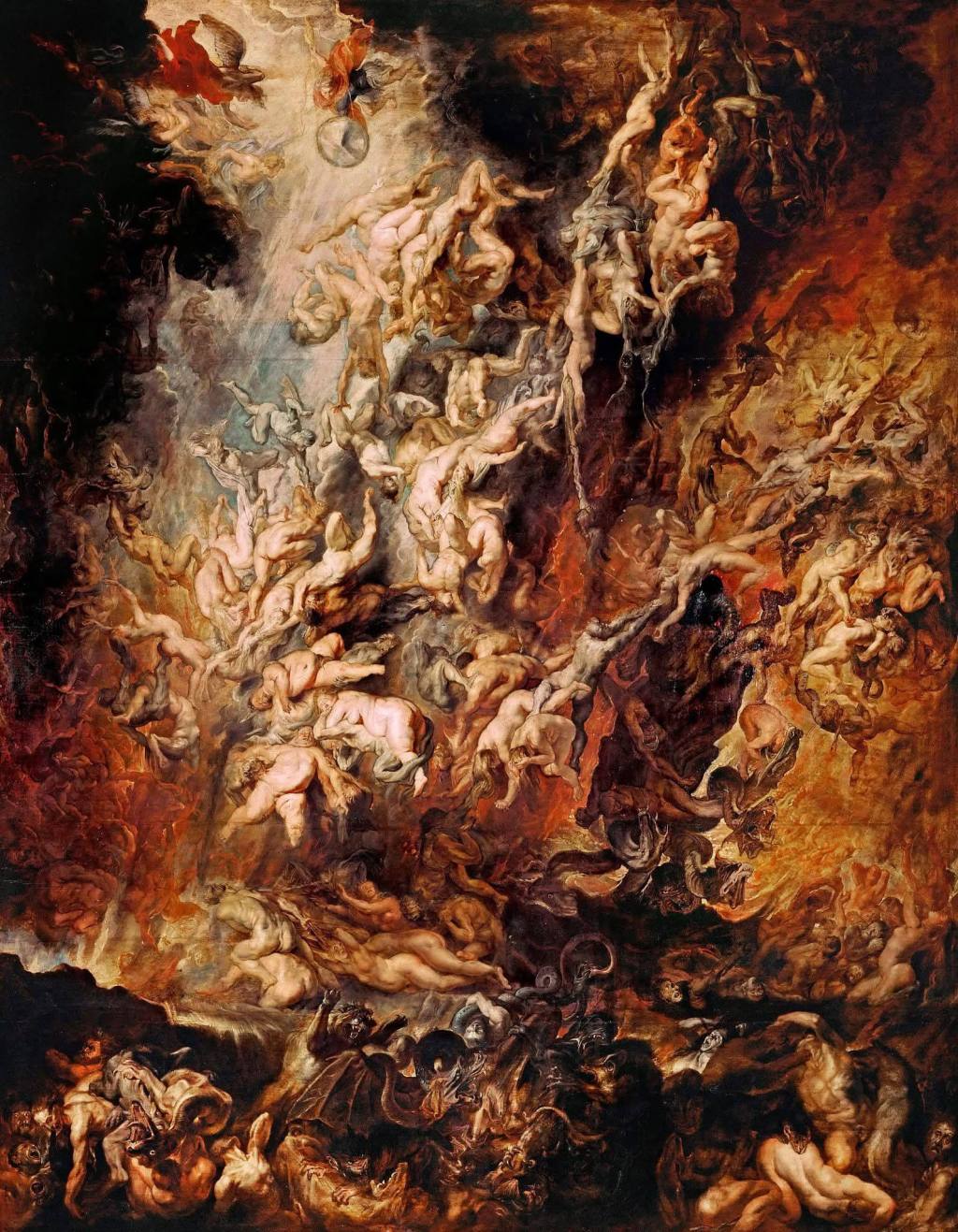
Up, The Fall of the Damned by Peter Paul Rubens (circa 1621)
Sources:
Doverspike, W. F. (2021). How to understand the seven deadly sins
The Origins of the Seven Deadly Sins
The Origins of the Seven Deadly Sins – 2
The Seven Deadly Sins – What Are They and Why Are They So Dangerous?
Who Are The Seven Princes of Hell?
Enciclopedia Dantesca – La Divina Commedia by Biblioteca Treccani (2005) — books in my library


 The Library of the Unseen

Penny for your thoughts…